热带气旋(TC)引发的极端降水(TCEP)对我国沿海地区构成严重威胁,但其季节预测能力仍受限于对跨尺度气候驱动因子认识的不足。传统研究多关注ENSO、太平洋和大西洋经向模等对流层—海洋因子对TC变率的影响,然而这些因子的季节预测解释能力仍然有限。平流层准两年振荡(QBO)作为赤道平流层的主导年际模态,对TC活动及极端降水的跨尺度调制作用尚未被充分揭示。近日,我院王会军院士团队周放副教授(通讯作者)、本科生王小敏(第一作者)、尹志聪教授(参与作者)等在国际期刊《Geophysical Research Letters》发表研究,揭示了QBO通过北半球夏季季节内振荡第二模态(BSISO2)调控中国东南沿海TCEP的跨尺度机制。该研究为提升TC极端降水季节预测提供了新的可预报性来源。
研究发现,在QBO西风位相(QBOW)夏季,西北太平洋TC路径向西北方向偏移,中国东南沿海TC登陆频率增加,TCEP较QBO东风位相(QBOE)夏季显著增加(图1)。进一步分析表明,BSISO2是连接QBO与TCEP的关键跨尺度“桥梁”。在BSISO2第4-6位相期间,QBOW夏季中国东南沿海TC登陆频率接近QBOE夏季的两倍,TCEP总量也接近QBOE夏季的两倍。BSISO2第4-6位相可解释QBOW与QBOE夏季TCEP差异年际方差的约60%。在物理机制上(图2a),QBOW夏季赤道平流层西风急流通过经向切变产生正涡度异常。该异常的下探,在东亚副热带对流层上层形成气旋性环流异常,并延伸至对流层中层。这一QBO诱导的正涡度背景与BSISO2第4-6位相环流叠加,增强中国东南沿海的涡度和水汽输送,从而有利于TC登陆及其降水效率提升,促使TCEP发生。若将QBO信号纳入双向逐步回归模型来拟合BSISO2-456位相下东南沿海区域TCEP分量,TCEP的拟合技巧相较仅使用ENSO信号因子可显著提升:时间相关系数从-0.12提高到0.42,解释方差从16.9%提高到37.0%,二分类预测AUC从0.77提高到0.97(图2b)。该结果表明,平流层QBO信号可为区域TCEP季节预测提供重要补充,具有业务应用潜力。
本工作得到国家自然科学基金项目(42394125)、国家重点研发计划项目(2024YFC3013100)以及安徽省自然科学基金江淮气象联合项目(2408055UQ004)的联合资助。
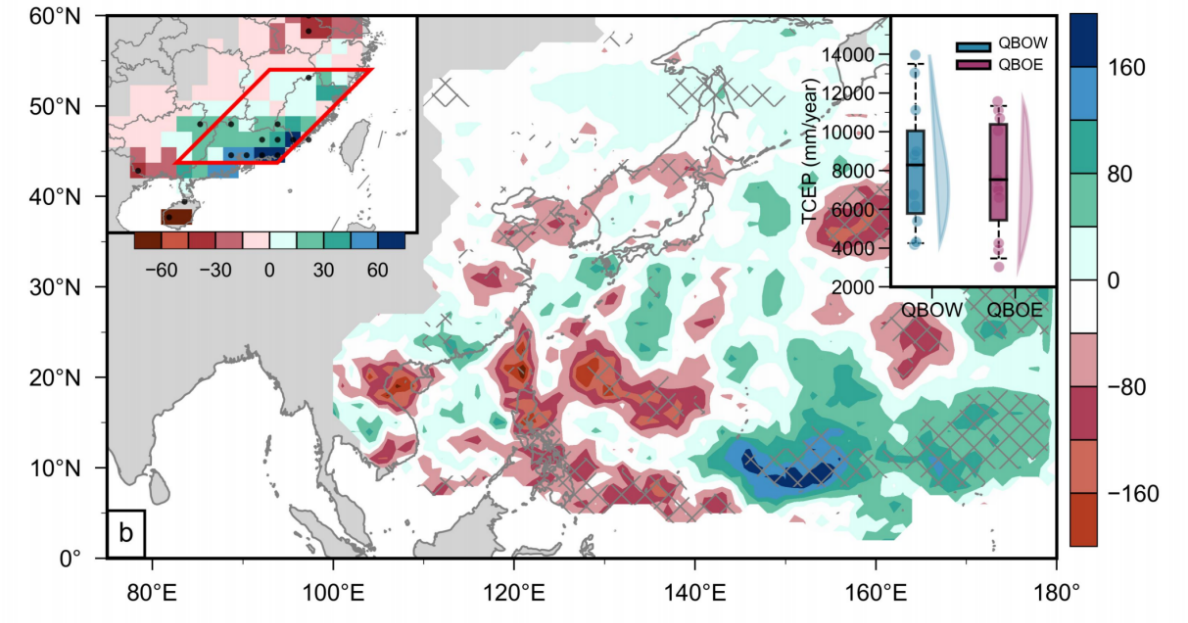
Figure 1. Difference in TCEP between QBOW and QBOE summers based on the GPCP global precipitation data set (unit: mm/year) with an enlarged view of southeast China coast based on the CN05.1 data set, overlaid with the probability density distribution of total TCEP in the red box region. The values in the box plots are the 5th (lower bound), 25th (lower quartile), mean, 75th (upper quartile), and 95th (upper bound) percentiles. Gray meshes and black dots indicate TCEP differences significant at the 90% confidence level based on a Monte-Carlo test.
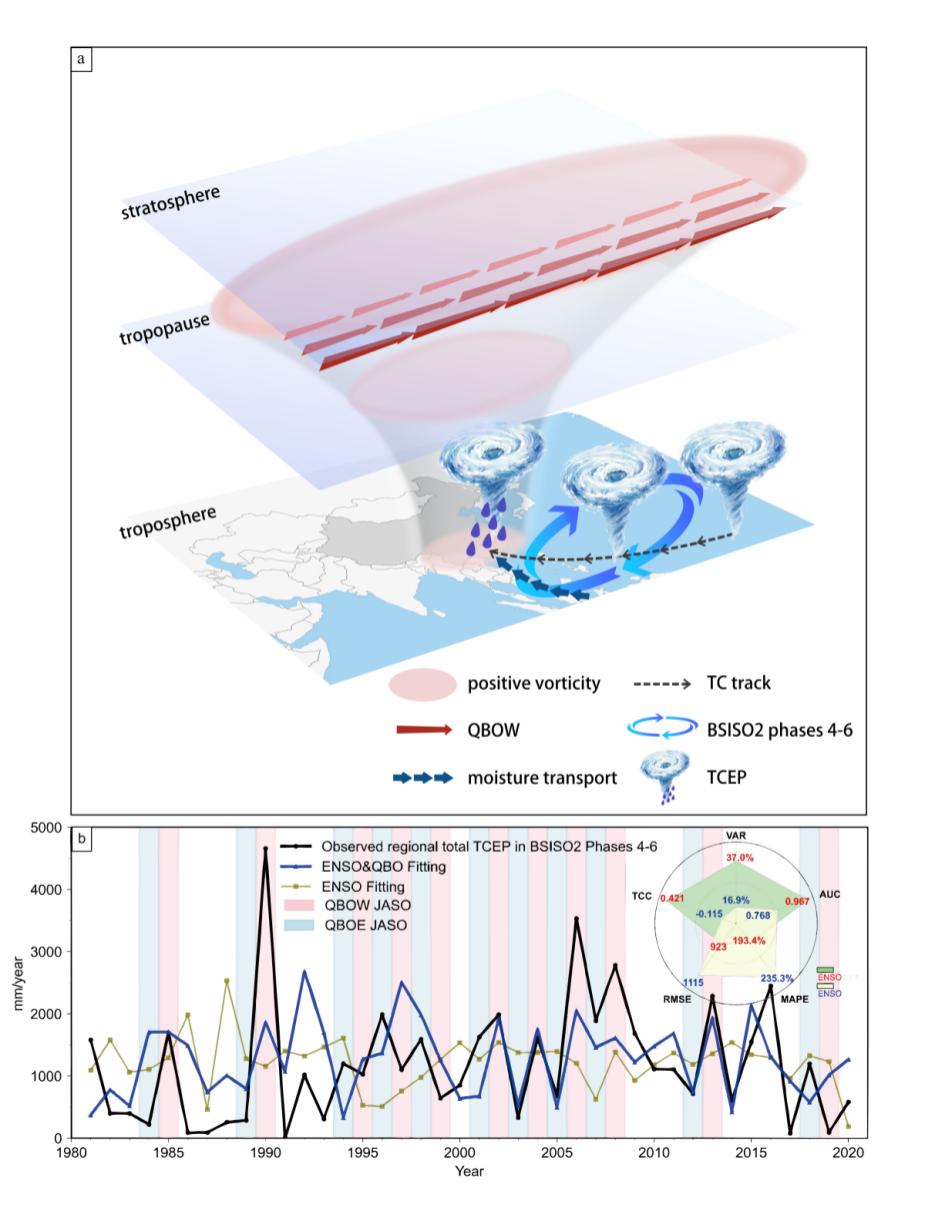
Figure 2. Mechanism and predictability of the QBO-BSISO2-TCEP linkage. (a) Schematic illustrating the proposed stratosphere-to-troposphere coupling pathway through which the quasi-biennial oscillation (QBO) and BSISO2 jointly modulate tropical cyclone activity and TCEP. (b) Time series of observed JASO TCEP over the southern China coast during BSISO2 Phases 4-6 (black dot line) and predicted TCEP from the ENSO-only (yellow dot line) and ENSO + QBO (blue dot line) models. Shaded areas correspond to different QBO phases: QBOW (red) and QBOE (blue). The top-right radar diagram compares the predictive skill metrics between the ENSO-only and ENSO + QBO frameworks.
相关文章:
Wang, X., Zhou, F., Yin, Z., & Liu, M. (2026). Stratospheric quasi‐biennial oscillation modulates tropical cyclone extreme rainfall over East Asia via intraseasonal oscillation. Geophysical Research Letters, 53(17), e2026GL124149.